Butterfly Life Cycle Worksheets – Free Printables for Kids
Butterflies give children a beautiful way to explore change. A tiny egg becomes a hungry caterpillar, the caterpillar forms a chrysalis and, after an amazing transformation, an adult butterfly emerges. With the right printable activity, this science idea becomes easier for young learners to see, talk about and remember.
These butterfly life cycle worksheets are designed for preschool, kindergarten and early elementary learners. The printable pack includes a life-cycle poster, stage-labeling activity, cut-and-paste sequencing page, matching activity, coloring worksheet, tracing page and a simple review sheet. Together, the pages support early science vocabulary, sequencing, fine-motor practice and creative learning.
Teacher and parent note: Children learn best when they can talk, move, draw, color and revisit a concept in several ways. Use these pages as a flexible learning invitation rather than a test.
What is the butterfly life cycle?
The butterfly life cycle is the series of stages a butterfly passes through as it grows. Butterflies experience complete metamorphosis, which means the young insect looks very different from the adult. The four stages are egg, larva or caterpillar, pupa or chrysalis and adult butterfly.
The four stages at a glance
| Stage | What children can remember | Simple science idea |
| Egg | A tiny beginning on a leaf | The egg protects a developing young insect. |
| Caterpillar | Eat and grow | The caterpillar eats, grows and sheds its skin several times. |
| Chrysalis | A quiet change | Inside the chrysalis, the body is reorganized into an adult form. |
| Adult butterfly | Wings and flight | The adult feeds, mates and begins the cycle again. |
Stage 1: Egg
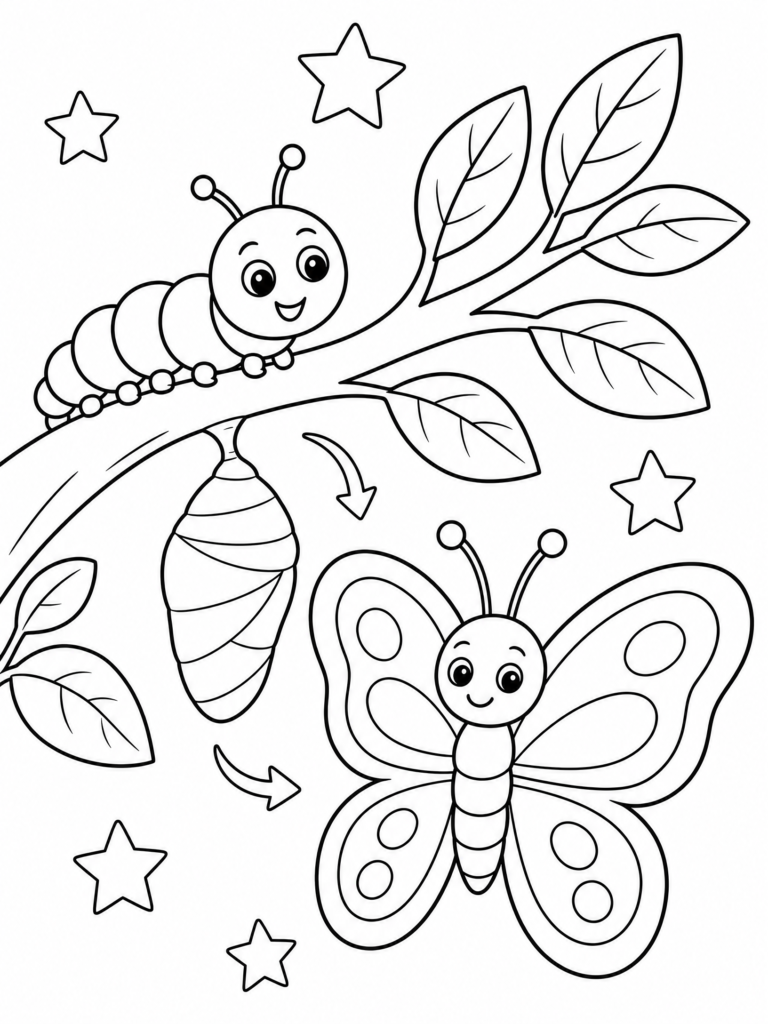
A female butterfly lays eggs on or near a plant that will support the young caterpillar. The eggs can be very small and may have different shapes depending on the species. When the caterpillar is ready, it hatches from the egg and begins searching for food.
Use the egg stage to introduce words such as tiny, leaf, hatch, beginning and protect. Children can draw a leaf, add small eggs and practice saying the first stage in order.
Stage 2: Caterpillar

The caterpillar is the feeding and growing stage. It eats plant material, becomes larger and sheds its outer skin as its body grows. A caterpillar may look simple, but it is already preparing for the next stage of its life.
You can describe the caterpillar as a “growing machine” without suggesting that it changes instantly. This is a good time to talk about healthy plants, gentle observation and the importance of leaving wild caterpillars where they are found.
Stage 3: Chrysalis

When the caterpillar has grown enough, it forms a chrysalis. The chrysalis is the butterfly’s pupa. It is not a sleeping shell; major changes are taking place inside. The developing adult forms its wings, legs, antennae and other body parts during this stage.
Children often enjoy the mystery of the chrysalis. Ask them what they think is happening inside, then compare their ideas with a simple explanation of metamorphosis.
Stage 4: Adult butterfly

The adult butterfly emerges with soft, folded wings. It must hang safely while fluid moves through the wing veins and the wings expand and dry. Once ready, the butterfly can fly, feed, find a mate and lay eggs to begin the cycle again.
A simple phrase helps children remember the order: egg, caterpillar, chrysalis, butterfly.
What is included in the printable pack?

The seven-page printable pack is designed to move from introduction to practice and review.
| Printable page | Activity | Main skill |
| 1 | Butterfly life-cycle poster | Visual overview and vocabulary |
| 2 | Label the four stages | Science words and recognition |
| 3 | Cut-and-paste sequencing | Ordering and fine-motor skills |
| 4 | Match the stage to the picture | Visual association |
| 5 | Butterfly life-cycle coloring page | Creativity and recall |
| 6 | Trace egg, caterpillar, chrysalis and butterfly | Early writing practice |
| 7 | Simple life-cycle review worksheet | Recall and independent thinking |
Download the printable: Butterfly Life Cycle Worksheets PDF
How to use the butterfly life cycle worksheets
Begin with the poster and read the four stage names aloud. Point to each picture while children repeat the words. Do not worry if preschoolers mix up the order at first; repetition and movement make the sequence more familiar.
Next, choose one practice page. A younger child may color the life-cycle picture while an older child labels the stages or cuts and pastes them in order. The goal is to offer an appropriate challenge without making the activity frustrating.
Finish with the review sheet. Ask children to explain the cycle in their own words. A child might say, “The egg hatches, the caterpillar eats, the chrysalis changes and the butterfly flies.” That simple explanation shows real understanding.
Butterfly life cycle activity for preschoolers
For preschool, keep the activity concrete and playful. Place four large picture cards around the room and invite children to stand beside the stage you name. Then have them act out each stage: curl up like an egg, wiggle like a caterpillar, become still like a chrysalis and flap arms like a butterfly.
Use the coloring page after the movement activity. Children often remember the vocabulary more easily when their bodies have participated in the sequence.
Butterfly life cycle activity for kindergarten
Kindergarten learners can add more detail. Ask them to draw arrows between the stages, copy the four key words and explain what happens in each part of the cycle. They can also compare the caterpillar and adult butterfly: one crawls and eats leaves, while the other flies and visits flowers.
To extend the lesson, let children create a mini nature journal. They can draw a plant, write one observation and add a question they would like to investigate.
Activity 1: Label the four stages
Give children the labeling page and read the word bank together. Younger children can match the words by looking at the first letter or by using the poster as a reference. Older learners can label the pictures independently.
Encourage children to say the entire sequence after completing the page. Speaking the words helps connect the printed labels with the scientific idea.
Activity 2: Cut and paste the life cycle
The sequencing page turns the life cycle into a hands-on puzzle. Children cut out the four stage pictures with adult guidance and glue them in the correct order. For children who are not ready to cut, an adult can cut the pieces first.
Ask, “What comes before the butterfly?” and “What happens after the egg?” These questions build sequence language without requiring a long written answer.
Activity 3: Match each stage to the picture
Matching is helpful for children who are still learning the difference between a caterpillar and a chrysalis. Invite them to draw a line from each word to the correct image or use colored stickers to make the pairs.
Avoid giving the answer too quickly. Let children look closely, compare the pictures and explain their thinking.
Activity 4: Color and tell the story
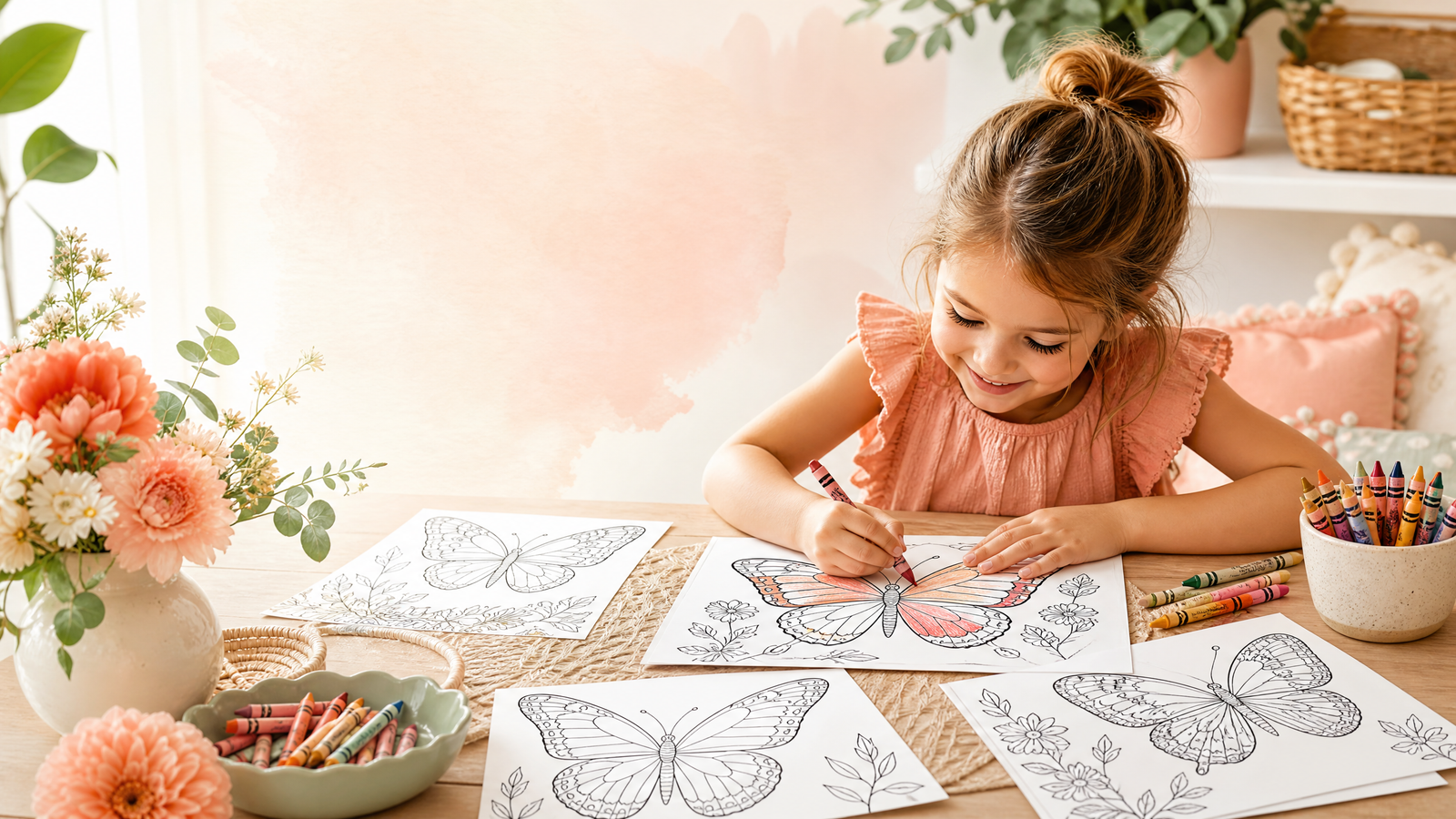
The coloring worksheet provides a relaxed way to review the science concept. Children can use their favorite colors or look at nature books for inspiration. The butterfly does not need to be realistic; imaginative colors make the activity personal.
After coloring, ask the child to tell the story from left to right or top to bottom. Write down their words if they want to create a caption.
Activity 5: Trace the science words
Tracing the words egg, caterpillar, chrysalis and butterfly gives children a gentle introduction to science vocabulary. Have them trace with a pencil, crayon or washable marker, then try writing one word without the guide.
For preschoolers, tracing is optional. Pointing, repeating and matching are valuable forms of participation too.
Activity 6: Review what children know
The final page can be used as a review, a small-group activity or a take-home page. Ask children to circle the first stage, draw a line to the stage that comes next or draw their favorite part of the cycle.
Do not treat this page as a formal assessment unless that is appropriate for your setting. Young children may know the concept but need help with pencil control or written answers.
More butterfly activities for kids
Pair these worksheets with the 10 Fun Butterfly Activities for Preschool article for crafts, movement games and sensory ideas. For a deeper explanation, link to Butterfly Life Cycle: The Complete Guide. You can also add the free butterfly coloring pages for kids for extra quiet-time practice.
A simple outdoor observation activity can make the printable lesson memorable. Look for butterflies near flowers, but observe from a respectful distance. Never handle wild butterflies or caterpillars, and wash hands after outdoor exploration.
Frequently asked questions
What are the four stages of a butterfly life cycle?
The four stages are egg, caterpillar, chrysalis and adult butterfly. The scientific terms are egg, larva, pupa and adult.
What age are these worksheets for?
The pack is suitable for preschool, kindergarten and early elementary learners. Adults can simplify the activities for younger children or add writing and research prompts for older children.
Is a chrysalis the same as a cocoon?
No. A chrysalis is the pupa formed by a butterfly. Many moths form a silken cocoon around the pupa, but butterflies generally do not spin a cocoon.
Can these worksheets be used in the classroom?
Yes. They are designed for personal, homeschool, library and classroom learning. Keep the Oh Simply Mom attribution with the printable, and do not sell or redistribute the files as your own.
How can I make the lesson more hands-on?
Use movement, stage cards, toy insects, a nature journal or a simple craft. Children can also create the four stages with play dough or arrange picture cards on the floor.
Final thoughts
A butterfly life cycle worksheet becomes more meaningful when it is part of a larger experience. Read a picture book, act out the stages, observe a garden and then return to the printable pages. Each activity gives children another way to understand the same beautiful idea.
Download the free pack, choose the pages that fit your child or classroom and enjoy learning about metamorphosis together.
References
[2] Monarch Joint Venture — Monarch Life Cycle
[3] NAEYC — Principles of Developmentally Appropriate Practice